The Return of Omotara Johnson: A Franchise That Forgot How to Be Dangerous
She Built an Empire on Fierceness, But the Sequel Chose Safety Instead
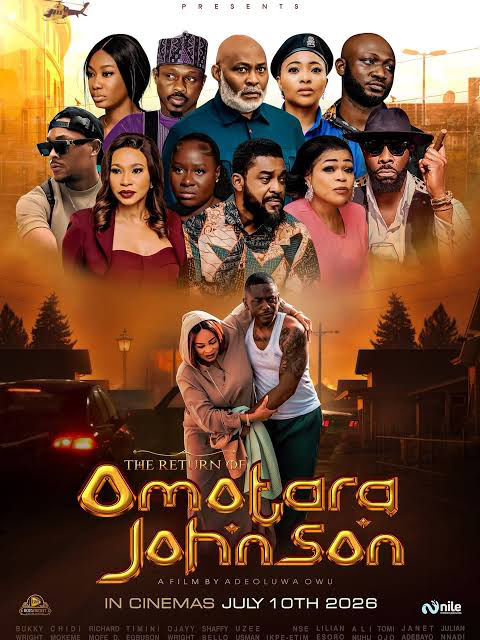
When Bukky Wright announced The Return of Omotara Johnson, the conversation wasn’t about whether she could pull it off. It was about what kind of reckoning was coming. The original three-part saga, released nearly two decades ago, mostly in Yoruba, gave us a woman who was wickedness incarnate, a character whose very presence on screen felt like a threat. Omotara Johnson wasn’t just fierce; she was the kind of antagonist who made you understand why people feared her, why people betrayed each other just to survive being in her orbit. That was the promise of this return: that this woman, this force of nature, was coming back to remind everyone exactly why she became one of Yoruba Nollywood’s most unforgettable characters.
But what we got instead was a film that understood the assignment in theory while missing it in execution. The shift from Yoruba to English, the strategic casting of mostly English-speaking actors, and the polished production values all felt less like evolution and more like an apology for what came before. The rough edges that made the original films memorable have been smoothed out in favour of something cleaner and more accessible. And that’s the real tragedy here because Omotara Johnson was never supposed to be palatable. She wasn’t built to be comfortable. She was built to make you uneasy.
When You Change the Language, You Change Who’s Listening
The decision to make this film predominantly in English, with only snippets of Yoruba, is being framed as expansion, as an attempt to reach new audiences. But let’s be honest about what it also does. It distances the film from the very audience that built the Omotara Johnson brand in the first place. The people who watched Omotara wreak havoc in Yoruba weren’t waiting for a polished, New Nollywood-adjacent version of the character. They were waiting for the return of something raw, something unapologetically local, something that spoke to them in the language that made the character feel authentic.
English inevitably softens that edge. It makes everything a little more digestible, a little more exportable, and a little less dangerous. Bukky Wright brought back only Chidi Mokeme from the original cast, and that alone tells you how intentionally this film positions itself somewhere between a sequel and a reboot. You can’t replace the chemistry and history that defined those earlier films and expect the same electricity to magically appear. It feels like the filmmakers believed new audiences would make up for the loss of that legacy connection. But that’s rarely how franchises work. When the foundation is built on cultural specificity, honoring that identity isn’t optional. It’s part of the experience.
The Fierceness Disappeared, and the Film Never Recovered
Bukky Wright is still commanding on screen, and her performance remains one of the film’s strongest assets. The problem isn’t her acting. It’s the version of Omotara Johnson she was asked to play. From the very beginning, she feels like a softened version of the woman we once knew. In the original trilogy, Omotara was a masterclass in controlled menace. Every look carried weight, every word sounded like a warning, and absolutely nothing stood between her and what she wanted.
Here, she still has flashes of that same fire, but they’re constantly restrained. The introduction of her son becomes the emotional anchor of the story, and while that sounds like a reasonable evolution on paper, it also becomes the reason the character can no longer be the unstoppable force she once was. Vulnerability doesn’t automatically make a character deeper. Sometimes it simply changes who they are.
Personally, I think the original Omotara Johnson would have loved her son just as fiercely but still burned the world down if she had to. She would have weaponised that love rather than allowed it to weaken her. Instead, the film presents a woman whose maternal instincts constantly pull her away from the very qualities that built her mythology. To be fair, every great character deserves a weakness, and hers isn’t unreasonable. It just didn’t make her return feel nearly as grand, intimidating, or unforgettable as I expected.
Good Performances Can’t Fix a Plot That Plays It Safe
The supporting cast all deliver solid performances, and bringing in veterans like RMD, Shaffy Bello and Nse Ikpe-Etim certainly gives the film commercial appeal. They’re familiar faces with undeniable screen presence, and if the goal was to broaden the film’s audience, the casting makes perfect business sense.
Narratively, however, they never feel as essential as they should. Their presence often feels imported rather than organically woven into Omotara’s world. The premise itself is actually compelling. A feared woman who has abandoned violence, found love, chosen peace, and is then dragged back into the darkness after being deceived and watching her son become the victim of a grave accusation is genuinely strong material. There was enough there to build something emotionally devastating and terrifying at the same time.
Instead, the film repeatedly chooses the safest route. Several twists arrive because the story needs them to happen rather than because the narrative naturally earns them. Even the ending feels like the most convenient plot device in the entire film. It resolves major conflicts far too neatly, almost as though the story was rushing towards a conclusion instead of allowing events to unfold organically. It could have been much tighter and far more satisfying. For a character like Omotara Johnson, unpredictability should be the engine driving every scene. Instead, the story often feels like it’s protecting her rather than unleashing her, and that caution ultimately robs the film of the danger its title promises.
Technically Sound, But Emotionally Hollow
From a technical standpoint, there’s very little to complain about. The cinematography is strong, the shot composition is intentional, and the production design reflects a film made with care and resources. The lighting works, the locations are attractive, and visually, the film consistently looks polished. It’s difficult to fault the craftsmanship.
The problem is that technical excellence alone doesn’t create emotional intensity. The editing, sound design and overall pacing are all competent, but competence isn’t the same thing as impact. A film called The Return of Omotara Johnsonshould feel like a reckoning. Every scene should carry the sense that something dangerous could happen at any moment. Instead, the film often feels measured, controlled and surprisingly restrained. Ironically, those are probably the last words anyone would have used to describe the original Omotara Johnson.
Maybe that restraint was intentional. Maybe the filmmakers wanted to show that time had changed her. If that was the goal, I understand it. I just don’t think it made for the most compelling version of this character. When you compare it to a film like King of Boys, where Sola Sobowale’s character is allowed to be completely ruthless and the filmmaking embraces that ruthlessness, the difference becomes impossible to ignore. The Return of Omotara Johnson had the resources to create that same kind of intensity. It simply chose not to.
It Was Good. But Good Isn’t Why We Came Back
At the end of it all, The Return of Omotara Johnson is a competent film. The performances work. The premise has merit. The production values are impressive, and Bukky Wright proves beyond doubt that she can still command a cinema screen. If you watch the film, you won’t have wasted your time or your money.
But that’s exactly where my disappointment lies. We didn’t return to Omotara Johnson because we wanted competence. We came back because we remembered danger. We remembered unpredictability. We remembered a woman who felt completely untouchable and utterly terrifying. Somewhere along the way, the film decided that version of Omotara needed to become more acceptable, more morally centred and easier to embrace. In doing so, it lost some of what made her iconic in the first place.
The Return of Omotara Johnson had every ingredient to become one of the year’s defining Nollywood releases. Instead, it’s a well-made film that never quite remembers why this character became a legend. I’d still encourage people to watch it and decide for themselves because there’s enough here to appreciate. But if you’re walking into the cinema expecting the Omotara Johnson from those original three parts to return fiercer, darker and more dangerous than ever, you may leave feeling exactly the way I did. Not because the film is bad, but because it had everything it needed to be so much more.


Comments